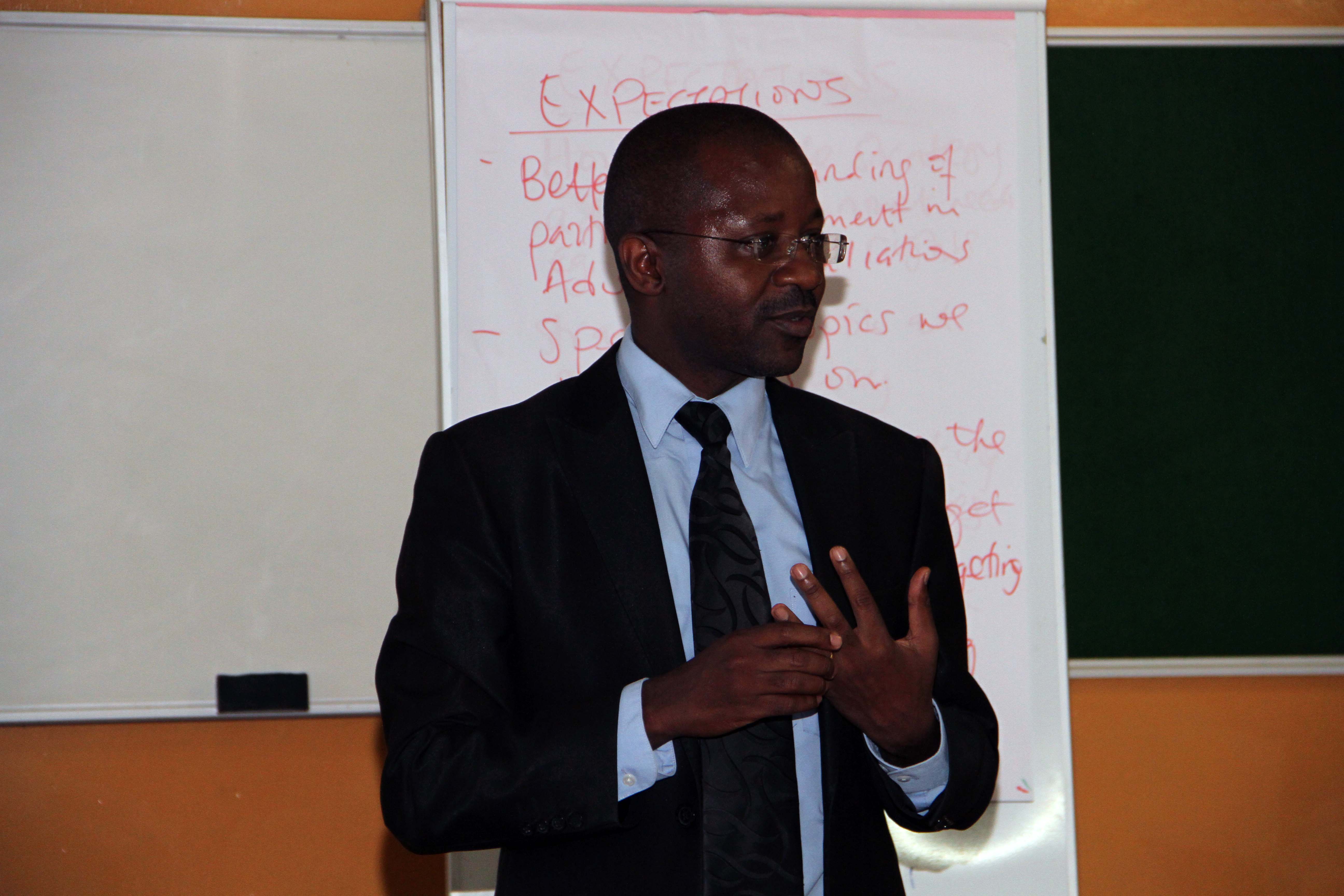
Budget advocacy is one of the most powerful tools civil society can use to hold governments accountable for commitments made around family planning and reproductive health. PAI sat with Dr. Moses Muwonge, budget expert and author of the 11-Step Budget Advocacy Guide to chat about the inspiration for the 11-step guide and his vision for what’s next. Dr. Muwonge is also co-chair of the Advocacy and Accountability Working Group of the Reproductive Health Supplies Coalition.
Q. Can you talk about some of the obstacles you’ve encountered doing budget advocacy work?
A. In 2010, I was contacted by Dr. Jotham Musinguzi, regional director for Partners in Population and Development Africa Regional Office (PPDARO). He said to me, “Moses, I want you to help us with budget tracking. I don’t know how you’re going to do it but I want to see money spent.”
I realized I needed to start from scratch working from outside the government system. I went to the Ministry of Health and started moving from office to office trying to figure out where the reproductive health commodities budget funds could be traced. I discovered money was sitting in banks, collecting interest, because the official request to release it had not been received.
Then I went to the National Medical Stores and asked, “Why aren’t you procuring?” They were waiting for a formal letter from the Ministry of Health instructing them on what to procure and in what quantities, but all they had received was the quantification report. I worked with the officer in charge at the ministry to ensure that the letters of instruction are written properly; Bit by bit, we mopped up all the money that was in the system and so we ended up spending more than was allocated (because of the interest gained while the funds were sitting in the bank). At the end of the year in 2011—two years after I first began to reflect on this issue—was the first time we saw progress.
Q. How was the 11-step guide born?
A. It was only when I was invited to present at a meeting in Brussells that I really started organizing it, and that’s how I came up with the 11 steps. Partners were very excited. Beth Frederick from Advance Family Planning and Wendy Turnbull from PAI played a big role in helping me to put the guide together in a systematic way so others could learn from it. I think that’s why people found it more useful. Ten drafts later, we had an 11-step advocacy guide.
Q. If you had to do a sequel to the 11-step guide, what would it be?
A. I’d like to have a regional capacity-building meeting using the guide so that Ministry of Health officials from different countries can understand the process. But budget advocacy is cyclical. Every year you start again from step one.
Q. How is budget advocacy linked to accountability in your opinion?
A. Everything we do is to make sure that commitments are realized. The difference is we are not pointing fingers but working with stakeholders and building their capacity. Even within the government, they don’t understand the processes because of disjointed systems and compartmentalization. This area is not something people study in school. We can’t even call it a technical field. I have a feeling the work we are doing now will be carried on by government officials themselves in the future.
Q. Since it’s been out, what’s the most surprising thing that’s come out of the 11-step guide?
A. It’s funny, when I was creating it, it really was difficult, but the comment I get from people is “thank you, this is so easy!”
Q. Why do you think that is?
A. Because they realize it’s do-able. When you explain it, you see the smiles on their faces. It used to be so complicated. They see we can hold these guys accountable. They also see how replicable it is. We go to different countries and do the same things and get the same results. I was afraid people would say, “this was developed in Uganda; it won’t work in my environment.” But it’s working.